




This page provides a comprehensive overview of the Continuous Threat Exposure Management (CTEM) framework and its five key stages: Scoping, Discovery, Prioritisation, Validation, and Mobilisation. It explains why CTEM is becoming essential in modern cybersecurity as organisations face increasingly complex threats. The page also outlines CTEM’s core components, the technologies that support it, its benefits, and the challenges organisations may encounter during implementation. In addition, it offers practical guidance on how to deploy an effective CTEM program, highlights emerging future trends, and concludes with the importance of adopting CTEM to strengthen overall security posture and protect digital assets.

 UK
UK
UK
UK
Knowledge CTEM Framework Explained: The 5 Stages of Continuous Threat Exposure Management
1. What Is CTEM?
Continuous Threat Exposure Management (CTEM) is becoming increasingly important in the field of cybersecurity. As organisations face more sophisticated and frequent cyber threats, there is a growing need to move beyond traditional vulnerability management approaches. CTEM offers a more dynamic and proactive way to identify, assess, and mitigate potential threats, helping organisations stay ahead of attackers and better protect their digital assets.
2. The Five Stages of CTEM
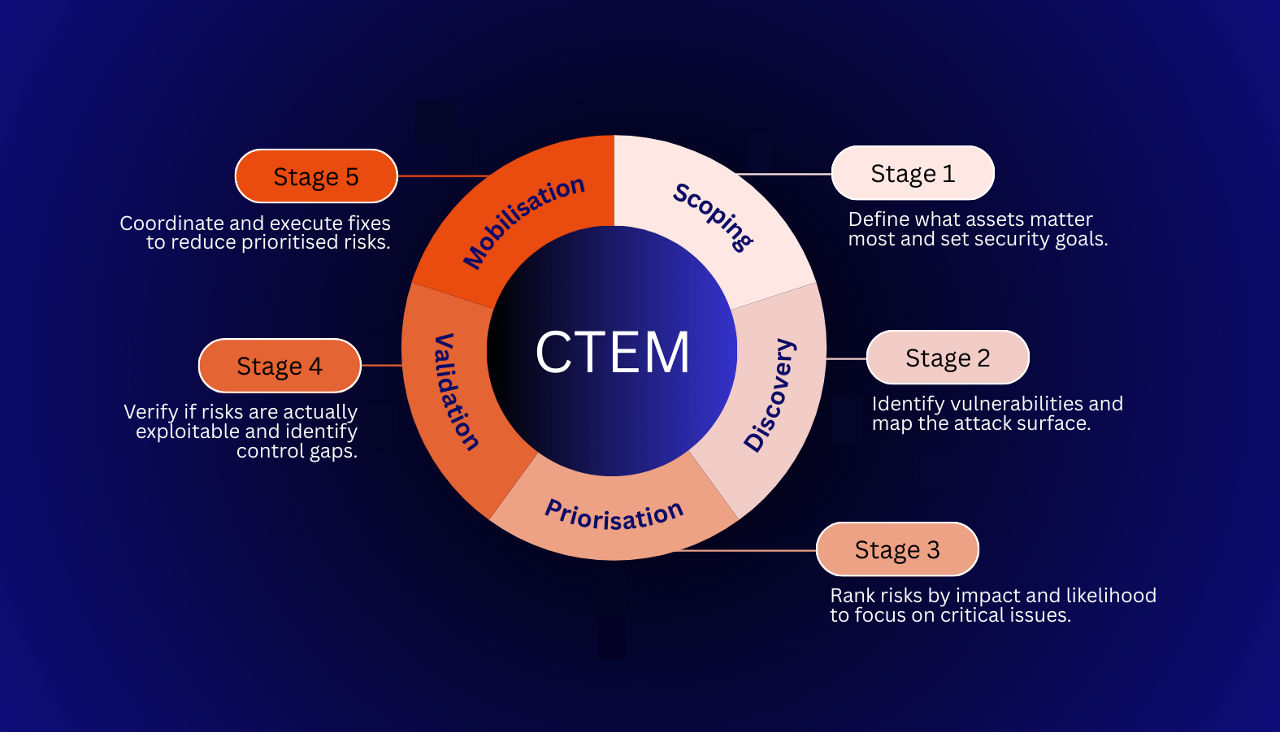
The Continuous Threat Exposure Management (CTEM) process is a comprehensive approach to identifying and reducing an organisation's exposure to cyber threats. It consists of five key steps:
Scoping
Begin by identifying the organisation’s most valuable and sensitive assets, such as customer data, intellectual property, and critical infrastructure. This step also involves mapping out all potential attack surfaces, including networks, applications, and third-party integrations, to understand where threats could emerge.
Discovery
Use automated tools and manual techniques to uncover vulnerabilities, misconfigurations, and exposures throughout the environment. This process helps reveal weaknesses in systems, software, and security policies that could be exploited by attackers.
Prioritisation
Analyse the identified risks by evaluating their potential impact on business operations and the likelihood that they could be exploited. This allows the organisation to focus resources on addressing the most significant threats first.
Validation
Test whether the discovered risks can actually be exploited in real-world scenarios, such as through penetration testing or simulated attacks. This step also assesses the effectiveness of existing security controls and identifies any gaps that need improvement.
Mobilisation
Develop and implement a coordinated response plan to remediate prioritised threats. This includes assigning tasks, deploying fixes or patches, updating security measures, and monitoring progress to ensure that identified risks are effectively mitigated.

By following these five steps, organisations can systematically manage and reduce their exposure to cyber threats.
3. Key Components and Technologies of CTEM
CTEM, or Continuous Threat Exposure Management, relies on several essential components and technologies to be effective. It involves continuous risk assessment and monitoring to identify and evaluate potential threats in real time. The integration of threat intelligence allows organisations to stay informed about emerging risks and vulnerabilities. Automation and the use of artificial intelligence and machine learning (AI/ML) play a significant role in managing exposures efficiently, helping to prioritise and respond to threats quickly. Additionally, CTEM is enhanced by integrating with various security tools such as SIEM (Security Information and Event Management), EASM (External Attack Surface Management), CNAPP (Cloud-Native Application Protection Platform), and others, creating a comprehensive and proactive security environment.
4. Benefits of Adopting CTEM
Adopting CTEM brings several key benefits to organisations:
- Improved visibility and real-time risk awareness: Businesses can continuously understand their security posture.
- Proactive risk reduction and faster remediation: CTEM enables organisations to address threats before they escalate.
- Business alignment and regulatory compliance: CTEM supports meeting legal obligations and maintaining trust.
- Enhanced operational efficiency: Reduces alert fatigue for security teams, helping them focus on the most urgent issues.
5. Challenges and Considerations in CTEM Implementation
Implementing CTEM comes with several challenges and important considerations. Organisations often face resource and skill constraints, making it difficult to allocate the necessary personnel and expertise. Integration complexity can arise as CTEM solutions must work seamlessly with existing systems and processes. Additionally, managing false positives and alert fatigue is crucial to ensure that teams can focus on genuine threats without becoming overwhelmed by unnecessary notifications. Finally, aligning teams and processes is essential for successful implementation, requiring effective communication and collaboration across different departments.
6. How to Deploy a CTEM Program: Best Practices & Measuring
To ensure a successful CTEM program, it's essential to align business objectives with clear scoping and prioritisation, foster cross-team collaboration and ownership, implement automation where it adds value, and maintain continuous improvement through regular feedback. Measuring the effectiveness of your CTEM efforts involves tracking key metrics such as mean time to detect and respond, reduction in critical exposures, elimination of attack paths, and compliance rates, along with reporting to demonstrate ROI.
7. Future Trends in CTEM
As organisations continue to face increasingly sophisticated cyber threats, several key trends are shaping the future of Continuous Threat Exposure Management (CTEM). First, the threat landscape is constantly evolving, with attackers adopting new tactics and techniques to bypass traditional defences. In response, organisations are turning to advanced technologies such as artificial intelligence, automation, and cloud-native tools to enhance their security posture and respond to threats more quickly and effectively. Additionally, there is a growing emphasis on integrating CTEM with Zero Trust principles and other emerging security frameworks, enabling a more holistic and adaptive approach to cybersecurity.
8. Conclusion
In summary, CTEM offers significant value to modern organisations by providing a comprehensive approach to cybersecurity. However, implementing CTEM can be a complex and challenging process, requiring dedicated resources and expertise. Despite these difficulties, CTEM is extremely important for maintaining business efficiency, as it enables organisations to proactively identify and address potential threats, enhancing their overall security posture. Therefore, adopting CTEM is essential for any organisation that wants to stay ahead of evolving cyber risks and ensure robust protection of their digital assets.
Learn more about Our Managed CTEM service, designed to support your organisation with or without an internal cyber security team.
KDDI Europe's Managed CTEM

Cyber Threat Intelligence Report

Related Knowledge Articles
What Is Information Security Education? Effective Training Topics and Methods to Raise Employee Awareness

Mar 23, 2026
Knowledge
SOCaaS: Why Organisations Prefer Managed Security Services

Mar 17, 2026
Knowledge
Latest Knowledge Articles
What Is Office DX? An Easy-to-Understand Guide to Its Benefits and Implementation

Mar 23, 2026
Knowledge
What Is Information Security Education? Effective Training Topics and Methods to Raise Employee Awareness
Mar 23, 2026
Knowledge
SOCaaS: Why Organisations Prefer Managed Security Services
Mar 17, 2026
Knowledge
Building an Office Network: Necessary Equipment, Steps, and Key Considerations

Mar 09, 2026
Knowledge
Complete Guide to Email Security Measures: A Thorough Explanation of the Latest Threats and Essential Countermeasures

Mar 09, 2026
Knowledge
Vulnerability Management vs. Pen Testing: Benefits, Limitations, and Alternative Security Approach

Feb 19, 2026
Knowledge
What Is a Security Assessment? Explaining Its Purpose, Evaluation Items, and Concrete Process

Jan 14, 2026
Knowledge
CTEM Framework Explained: The 5 Stages of Continuous Threat Exposure Management
Jan 14, 2026
Knowledge
What Are Managed Services? Explaining the Service Features and Benefits That Support Corporate IT Departments

Jan 14, 2026
Knowledge
What Is Cybersecurity? A Beginner-Friendly Guide to the Basics and Key Countermeasures

Jan 14, 2026
Knowledge
What Is a Vulnerability Assessment? Explaining Its Necessity, Costs, and How to Choose a Service

Dec 18, 2025
Knowledge
What Is a Cyberattack? Main Types, Techniques, and Measures Companies Should Implement Immediately

Dec 18, 2025
Knowledge
What Are Cloud Security Services? Explaining the Main Types and Key Points for Choosing a Service

Dec 18, 2025
Knowledge
What Are MDM Security Measures? Explaining Features That Prevent Data Leaks and Key Points for Choosing a Service

Dec 18, 2025
Knowledge
Complete Guide to IAM: Benefits, Security Risks & How It Works
Jun 24, 2025
Knowledge
4 Solutions for Visualizing CO2 Emissions! Features and Advantages Explained

May 07, 2025
Knowledge
Practical Approaches for Global Carbon Neutrality

Apr 30, 2025
Knowledge
A Detailed Explanation of the Importance and Benefits of Using IT for Carbon Neutrality

Apr 24, 2025
Knowledge
Introducing Carbon Neutrality Initiatives by Region and Country – What Are the Risks of Delayed Action?

Apr 16, 2025
Knowledge
OT Security – An Essential for Overseas Locations and Factories: Introduction to Risks and Specific Countermeasures

Mar 13, 2025
Knowledge
What is the NIS2 Directive? Introducing its requirements and the need for cyber resilience

Mar 06, 2025
Knowledge
Cybersecurity in the Academic Environment – The Threat from Anyone, Anywhere, at Any Time.

Jan 24, 2025
Blog
What is ITOC? - IT Operation Centre: 24/7 IT Support, Monitoring, and Incident Management

Oct 25, 2024
Blog
The Role of Security and IT Service Integrators Amidst Growing IT Product Vulnerabilities
Oct 21, 2024
Blog
Creating a Society in which Anyone Can Make Their Dreams a Reality, Starting from Japan—KDDI's Launch of "WAKONX (WAKON-CROSS)", a Business Platform for the AI Era

Aug 23, 2024
Knowledge
What is Zero Trust (Security Measures for IoT) at Overseas Offices? Points to Realize

Jun 27, 2024
Knowledge
What is Endpoint Security? Explaining its Importance in the Zero Trust Model and Best Practice at Overseas Offices

Jun 26, 2024
Knowledge
On What Threats Should We Focus in Overseas Offices? Explaining the Idea of Zero Trust

Jun 19, 2024
Knowledge
What are the Components of Zero Trust? Explaining the Best Security Technology Required for the IT Environment that is Becoming Increasingly Diverse at Overseas Offices

Jun 18, 2024
Knowledge
How do you strengthen IT governance at overseas locations? Expanding KDDI networks across the globe to comprehensively support the IT governance in and outside Japan
May 22, 2024
Knowledge
The process of establishing, relocating, and renovating offices overseas

May 16, 2024
Knowledge
Key information security measures when smart office enabling overseas locations

May 09, 2024
Knowledge
Overview of business reviews and other measures for creating a smart office

Apr 25, 2024
Knowledge

What is the best solution for your problem?
Please consult a KDDI consultant.
General Inquiry: 0800-631-3131
Office Hours: 9:00~17:00
(Closed Saturday, Sunday, and UK Bank Holidays)