





Please select a language

Please select the country/region where you would like to introduce your business.

Contact Us
Contact Us

Please select a language

Please select the country/region where you would like to introduce your business.

Knowledge A Complete Guide to the Office Design Process! What Are the Key Points to Success?

Share


A Complete Guide to the Office Design Process! What Are the Key Points to Success?

Office design plays an extremely important role in supporting corporate growth and creating a comfortable working environment for employees. Office design is not simply about arranging desks and chairs; it is about optimizing space according to corporate philosophy, business strategy, and workstyle. By designing an office appropriately, companies can expect benefits such as improved productivity, more active communication, and improved employee satisfaction.

This article comprehensively explains everything from basic knowledge of office design to specific procedures and key points for avoiding failure.
1. What Is Office Design?

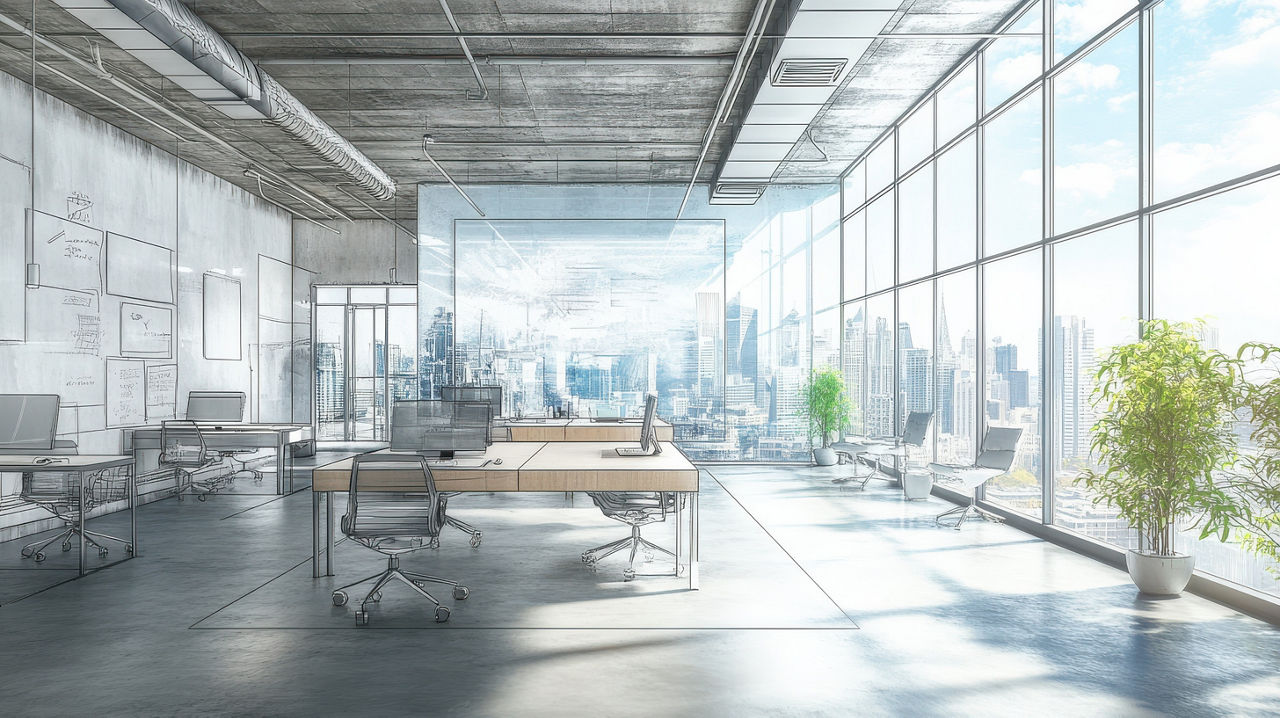
Office design refers to planning the overall structure, layout, and design of an office space in order to achieve a company’s objectives and business strategy. It is an important initiative that builds an environment where employees can work comfortably and efficiently, while also serving as the foundation for forming corporate culture.

Creating an Environment That Encourages Employee and Corporate Growth

Excellent office design is directly linked to employee comfort and ease of work. By appropriately placing quiet spaces where employees can concentrate on tasks and collaboration areas where ideas can be casually exchanged, it is possible to bring out employees’ maximum performance. This encourages individual growth, leading to improved productivity and strengthened organizational capabilities for the company as a whole.

Why Office Design Has Become More Important in Recent Years

In recent years, the importance of office design has increased along with the diversification of workstyles and intensifying competition to secure talent. As hybrid work combining remote work and office work becomes more widespread, the role of the office is changing from simply being a place to work to a place for communication and the creation of new value. An attractive and functional office not only increases employee engagement but also serves as an important factor in communicating the company’s appeal during recruitment activities.

2. Three Benefits of Office Design

What specific benefits can companies gain by focusing on office design? This section explains three primary benefits.

Improved Productivity

A properly designed office increases employee concentration and creativity, contributing greatly to improved productivity. For example, by incorporating the concept of ABW, or Activity-Based Working, which allows employees to choose work locations according to the content of their tasks, or by installing private booths that can be used when concentration is needed, employees can work in the environment best suited to their tasks.

Relationship Between Office Design Ideas and Productivity Improvement

Design Idea Expected Productivity Improvement
Installation of focus booths Enhances individual concentration and improves work efficiency
Expansion of collaboration areas Encourages spontaneous communication and supports the creation of new ideas
Optimization of traffic flow Smooths movement between departments and reduces time loss in operational collaboration

Improved Employee Satisfaction

Office design that emphasizes ease of work greatly influences employee satisfaction. Comfortable refreshment spaces and bright workspaces with natural light support employees’ physical and mental health and lead to improved motivation toward work. Higher employee satisfaction leads to reduced turnover and improved retention, producing significant benefits from the perspective of long-term talent acquisition.

Improved Corporate Brand Image

Office design also serves as a medium for communicating a company’s philosophy and values both internally and externally. By incorporating corporate colors and logos into the design of entrances and meeting rooms, companies can effectively impress their brand image upon visitors. Creating this kind of office space not only supports external branding, but also fosters employees’ sense of belonging and organizational unity as part of inner branding.

3. Basic Office Design Process

To create the ideal office, it is essential to proceed with the project in a planned manner. This section explains four basic steps in office design.

Step 1: Identify Current Issues

First, it is important to clarify the issues facing the current office. When proceeding with office design, conduct employee surveys and interviews to identify specific problems such as “communication is difficult,” “there are not enough meeting rooms,” or “the break area is too small.” By gathering a wide range of feedback from the workplace at this stage, the accuracy of later office concept design and layout planning will improve.

Step 2: Decide the Office Concept

Next, decide the concept of the new office based on the identified issues and the company’s desired future state. By setting a clear concept such as “an office with active communication” or “an office that generates innovation,” consistency is created in the design and layout. This concept will become an important criterion for later office design decisions.

In recent years, the concept of a “DX office,” which uses digital technology to transform operations and workstyles, has also become more widespread. Incorporating this direction at the concept design stage can improve future expandability and competitiveness.

Step 3: Divide the Space Through Zoning

Once the concept has been finalized, perform zoning. Zoning means roughly dividing office areas according to use, purpose, information confidentiality, and security level. For example, divide the office into public spaces used by visitors, workspaces where employees work, and security spaces where confidential information is handled, then consider the arrangement and traffic flow for each.

Step 4: Decide Specific Placement Through Layout

After determining the broad framework through zoning, move on to layout design, where you decide the specific placement of desks, chairs, cabinets, and other items. Plan arrangements that balance comfort and functionality, taking into account the size of each employee’s workspace, passageway width, and ease of collaboration between departments. At this stage, creating 3D perspectives and sharing the completed image can help prevent differences in understanding among stakeholders.

4. Office Design Points by Area

An office consists of various areas, each requiring different functions and roles. This section explains design points for major areas.

Entrance: The Face of the Company

The entrance is the first space visitors see and is truly the “face of the company.” It should effectively use the company logo and corporate colors to convey the brand image. It is also essential to consider functionality that balances comfort and security, such as installing a reception system, securing a waiting area, and designing traffic flow that properly separates visitors from work areas.

Workspace: A Key Factor in Work Efficiency

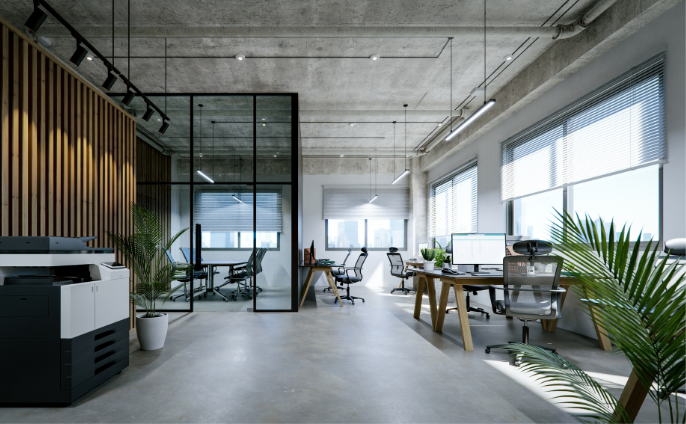
The workspace is where employees spend the most time, and its design directly affects work efficiency and information security. It is important to choose desk arrangements according to work content and workstyle, such as an opposing layout if collaboration within departments is important, or a back-to-back layout if you want to balance concentration and communication. In recent years, more companies have adopted free-address seating without fixed seats. In such cases, operational considerations such as measures to prevent screen viewing and rules for document management are also essential.

Layout Type Advantages Disadvantages
Opposing layout / island layout

Encourages communication within departments

May make collaboration with other departments less likely
Same-direction layout

Makes it easier to secure privacy and concentrate

Makes communication more difficult
Free-address seating Effective use of space and promotion of interaction with other departments May weaken communication and information sharing within teams

Meeting Rooms and Reception Rooms According to Purpose

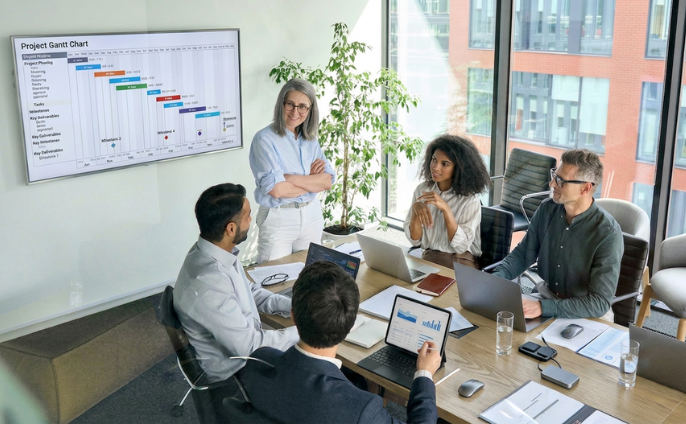
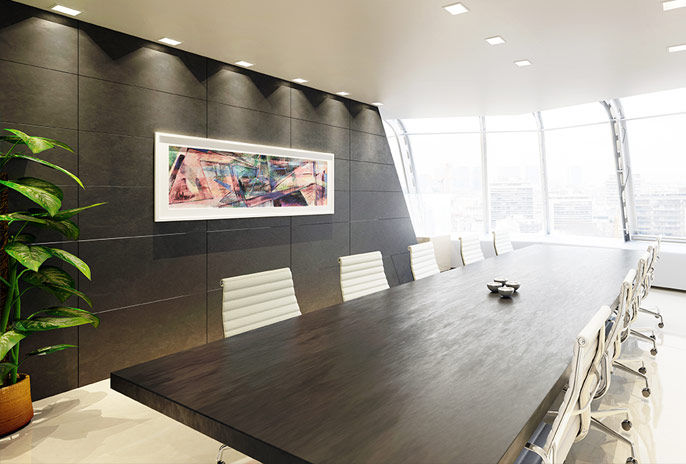
Meeting rooms and reception rooms should be designed after clarifying their purpose and the number of users. Reception rooms used to welcome clients should have high-quality interiors that convey a positive image of the company, while meeting rooms intended to encourage active discussion should emphasize functionality by installing large monitors, whiteboards, and other tools. Efficient and secure operation can be achieved by introducing reservation systems and clarifying usage rules.

Refreshment Spaces That Soothe the Mind and Body

To maintain employees’ physical and mental health and sustain productivity, refreshment spaces where employees can take quality breaks are important. By creating an atmosphere different from the work area, such as a café-like relaxing interior, or by installing massage chairs and nap spaces, you can enable employees to effectively reset their minds and bodies. At the same time, design the space with attention to zoning and usage rules so that work-related information is not unintentionally seen or overheard.

5. Points to Note to Avoid Mistakes in Office Design

Office design is a project that requires a large investment and considerable time. To avoid mistakes, understand the points that require caution in advance.

Be Sure to Check Relevant Laws and Regulations

Laws such as the Building Standards Act, Fire Service Act, and Industrial Safety and Health Act are involved in office design and construction. There are many items that must be complied with, including securing evacuation routes, sprinkler installation standards, and the required area per person in workrooms.

Also, when designing and building an office overseas, you must note that building standards, fire regulations, and occupational safety laws differ greatly by country and region, such as state or city. Instead of nationwide uniform standards like in Japan, unique regulations are often applied at the local government level. Depending on the region, stricter safety standards than those in Japan may be required.

If you proceed with design while ignoring these regulations, large-scale revisions may be required later, so be sure to confirm them with specialists at the planning stage.

Conduct Appropriate Budget Management

Office design involves various costs, including design fees, interior construction costs, and furniture purchases. It is important to clarify the overall budget at the initial stage of the project and allocate costs to each item according to priority, such as work efficiency and security measures. It is also a good idea to secure a certain contingency budget in preparation for unexpected specification changes or additional construction. Remember to obtain estimates from multiple contractors and compare the balance between cost and quality.

Ensure Security and Safety

To build an environment where employees can work with peace of mind, ensuring security and safety is the top priority. It is necessary to introduce access control systems in areas where confidential information is handled to prevent unauthorized entry and information leakage, and to thoroughly implement physical measures such as clarifying evacuation routes in preparation for disasters. Incorporating the perspective of universal design, which makes the office easy for everyone to use regardless of age or physical characteristics, is also important for creating a safe office environment.

As workstyles change, office design trends continue to evolve. This section introduces three trends that have attracted attention in recent years.

ABW for Diverse Workstyles

ABW, or Activity-Based Working, is a workstyle in which employees autonomously choose where and when to work according to task content and purpose. Offices that implement ABW provide diverse workspaces such as private booths for focused work, booth-style seating suitable for discussions among multiple people, and sofa seating where employees can work while relaxing. By allowing each employee to choose the optimal environment, improvements in productivity and satisfaction can be expected. At the same time, operational design including ICT environments and information security becomes important.

Biophilic Design That Incorporates Nature

Biophilic design is a design method that incorporates natural elements such as plants, natural light, and wood into office spaces in order to satisfy the instinctive human desire to connect with nature, known as biophilia. Scientific evidence shows that arranging indoor plants and creating layouts where natural light can be felt can reduce employee stress and improve creativity.

Casual Spaces That Encourage Communication

New innovation is often born from spontaneous communication, or serendipity, in the office. For this reason, more companies are intentionally designing spaces where communication is likely to occur. For example, by installing coffee stands or bar counters, or by creating open layouts that remove barriers between departments, companies encourage natural interaction among employees.

7. How to Choose a Reliable Office Design Contractor

To make office design successful, choosing the right partner contractor is extremely important. Use the following points as a reference to select the best contractor for your company.

Check Whether They Have Extensive Experience and Case Studies

First, check the company’s website and other sources to confirm past achievements and specific construction examples. If they have many examples involving companies close to your company’s industry and size, you can expect them to have a strong understanding of industry-specific issues and needs. From the perspectives of information security and business continuity, it is also important to check whether they have experience appropriately designing access control and zoning. Whether the design taste matches your company’s image is also an important criterion.

Check Whether They Can Provide One-Stop Support

Office design projects cover a wide range of processes, from concept development to design, interior construction, furniture selection, moving, and after-sales follow-up. If the contractor can handle all of these processes consistently through one-stop support, it can greatly reduce the burden on your side and enable the overall project to proceed smoothly.

Assess Compatibility With the Contractor’s Representative

Smooth communication with the contractor’s representative is essential for the smooth progress of the project. Through meetings, assess their responsiveness and attitude, including whether they accurately understand your requests and provide appropriate proposals based on professional knowledge, and whether they respond promptly and sincerely to questions and concerns. Choosing a partner with whom you can build a relationship of trust leads to stable project management with fewer misunderstandings and risks.

8. Summary

Office design is not simply the creation of space; it is an important management strategy for creating the future of the company. Refer to the procedures and points explained in this article to solve your company’s issues and create an ideal office environment where each employee can fully demonstrate their abilities. Work with a reliable partner to make your office design project a success and accelerate corporate growth.

Comfortable office design requires not only an attractive layout but also an easy-to-use IT environment that considers security and operability. KDDI provides one-stop proposals covering everything from interior design to network and ICT infrastructure.

Let us help you create a next-generation office space that combines functionality and design. Please check the link below for details.

Related Services

Do you need more information?

Construction of IT Infrastructure Prone to Be Forgotten at Opening, Moving, or Renovating Overseas Office

Connect with KDDI consultants for inquiries and quotations.

Latest Knowledge Articles

What is a SOC-as-a-Service?
What is SOCaaS?
Apr 08, 2026
Knowledge

What is the best solution for your problem?
Please consult a KDDI consultant.

General Inquiry: 0800-631-3131

Office Hours: 9:00~17:00
(Closed Saturday, Sunday, and UK Bank Holidays)